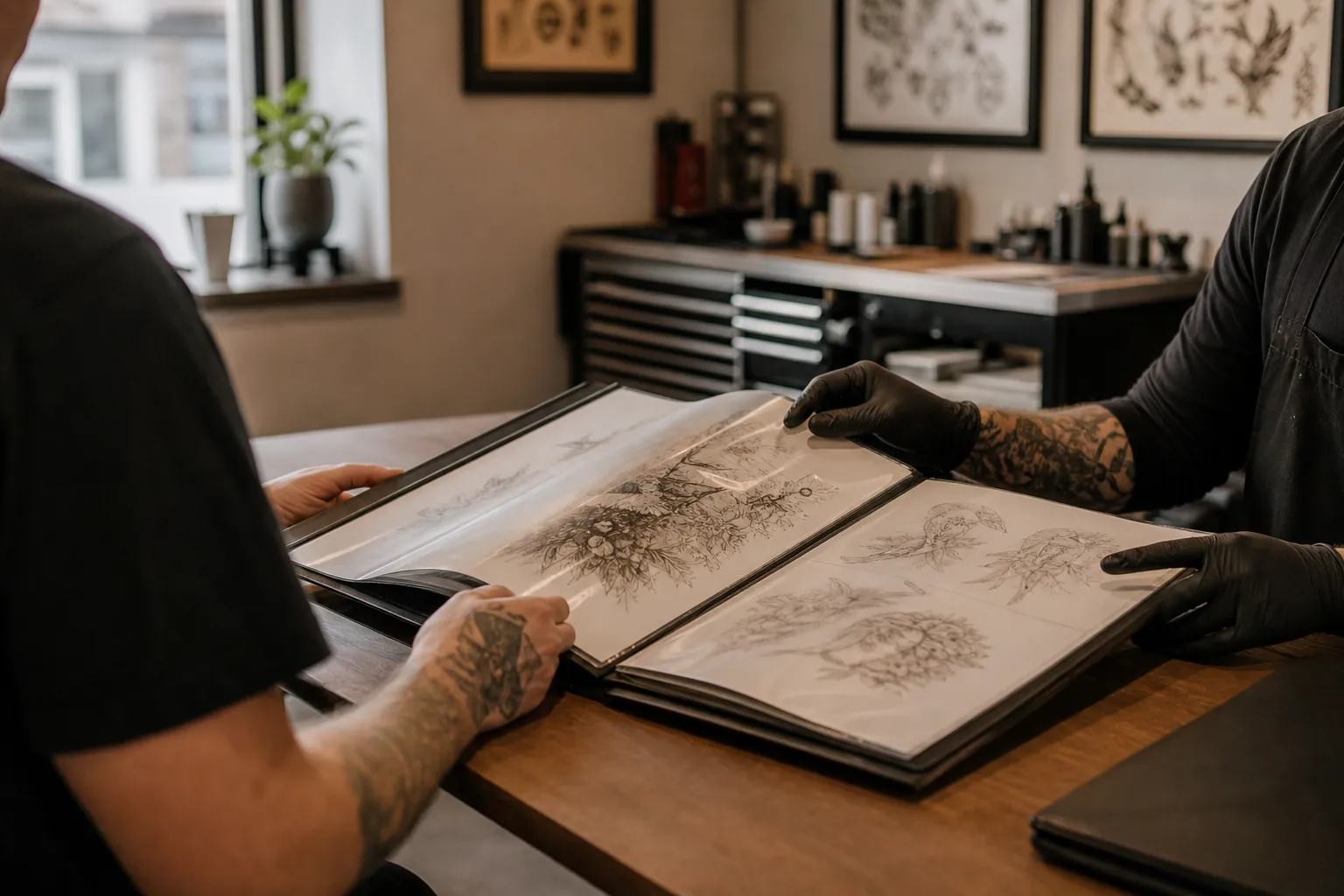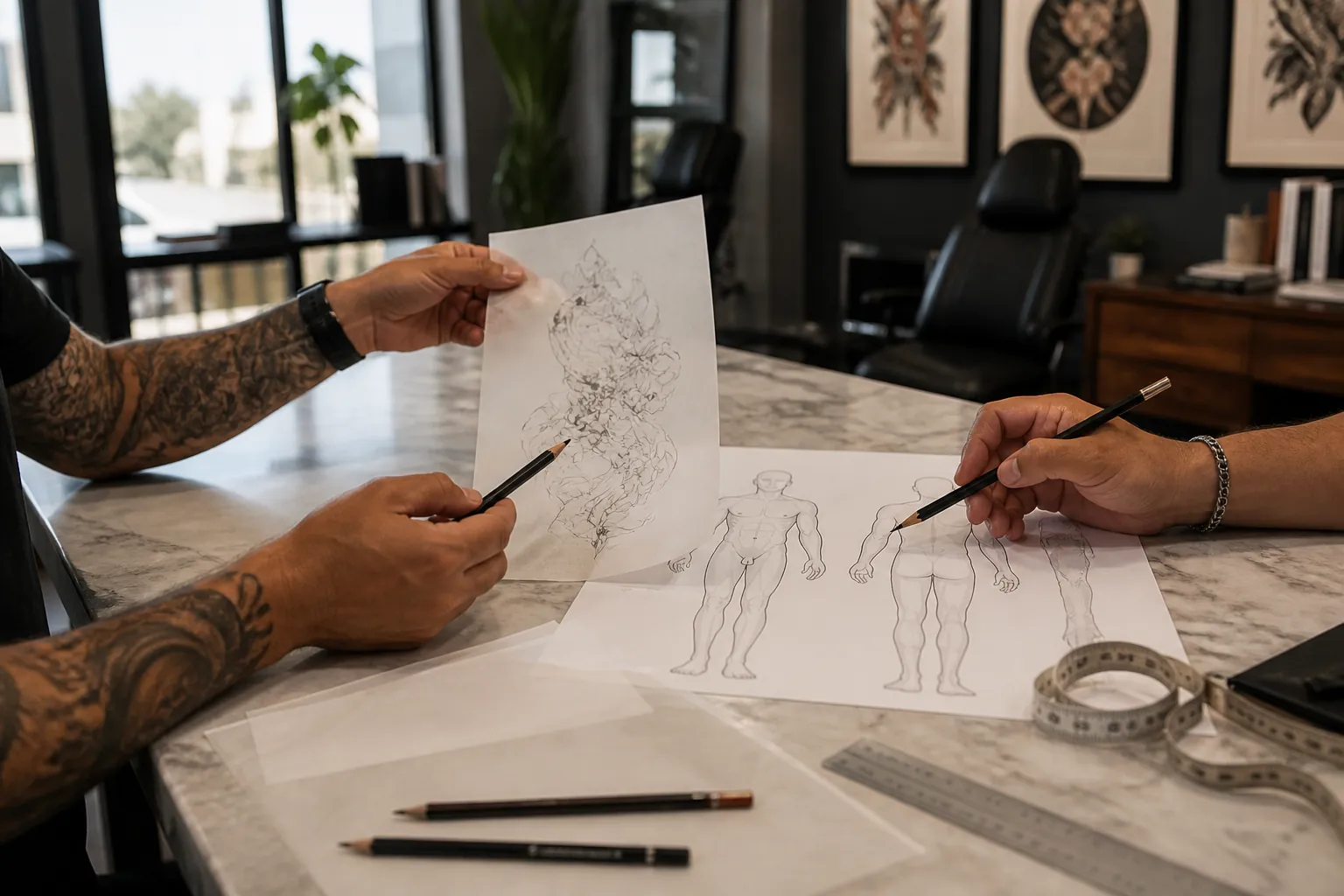
Portfolio Literacy / U.S. field guide
How to Read a Tattoo Artist's Portfolio
A portfolio is not a highlight reel to admire passively. Read it as evidence of style, execution, healing, and relevance to your own project.
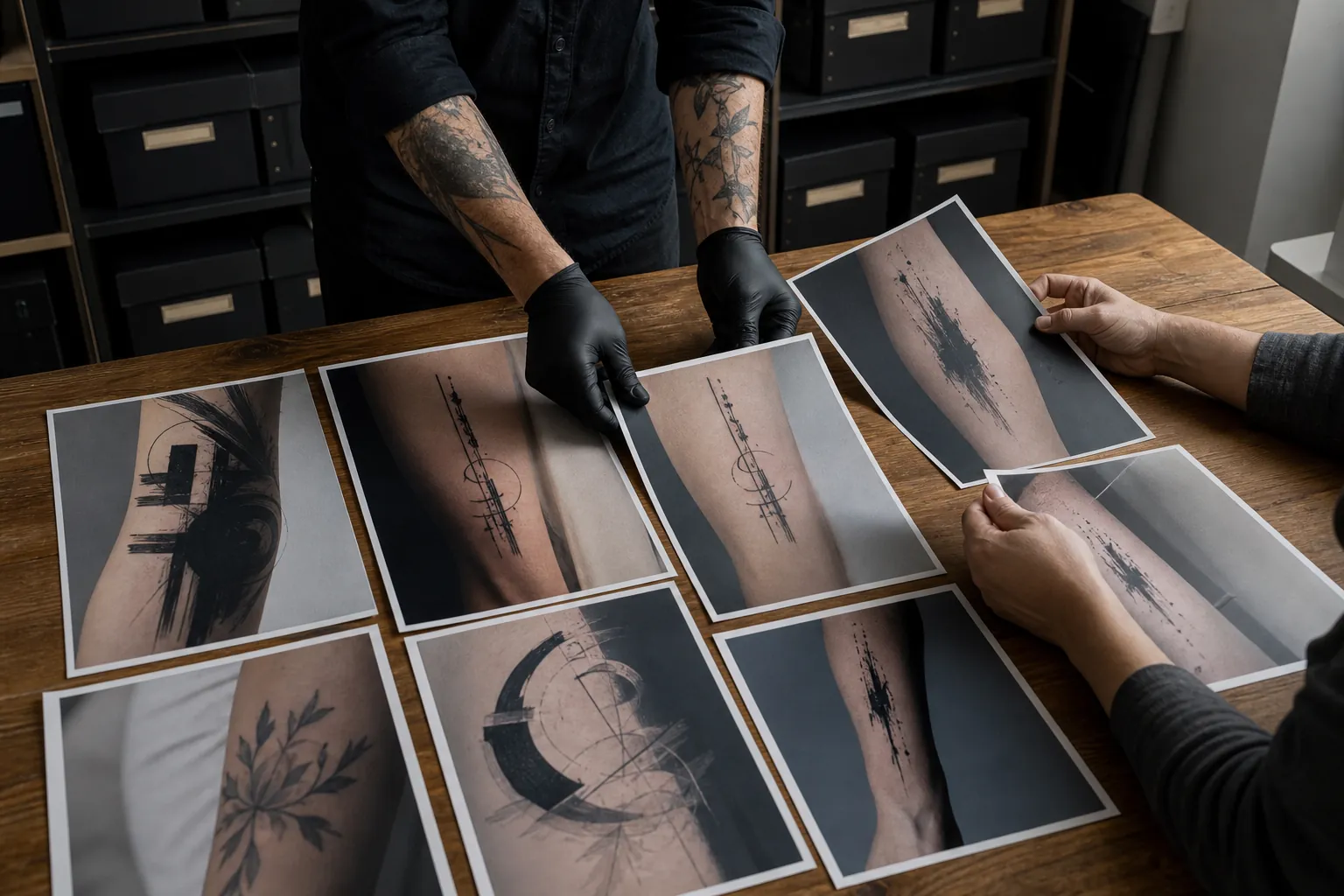
Look for repeated evidence across projects, not one flawless hero image.AI-generated editorial illustration; not a listed artist’s work.
A strong tattoo portfolio does more than prove that an artist owns a camera and has produced a few impressive pieces. It shows patterns: which visual problems the artist chooses, how they solve them across different bodies, and whether the results remain convincing beyond the fresh-photo moment. Learning to read those patterns is one of the most useful skills a client can develop.
Separate the Portfolio From the Social Feed
A social feed may contain tattoos, drawings, travel, memes, convention announcements, healed updates, and reposted inspiration. A portfolio is the subset presented as evidence of the artist's own work. Before evaluating quality, identify what you are looking at. Check captions, collaboration credits, studio tags, and whether the same piece appears on a current artist profile or studio page.
Do not assume every image in a grid was designed and tattooed by the account owner. Some studios post work from multiple residents and guests. Some artists share paintings or digital concepts that show taste but not tattoo execution. Those posts can still be valuable; they simply answer a different question. A drawing demonstrates design direction. A healed tattoo demonstrates an outcome on skin.
Follower count, likes, and professional photography may help work travel farther, but none measures suitability for your tattoo. Algorithms reward novelty, timing, and presentation. Build your assessment from multiple relevant pieces rather than the most viral image.
Understand Fresh, Settled, and Healed Photographs
A fresh tattoo is commonly photographed immediately after the session. The skin may be red, raised, reflective, or affected by cleaning products and lighting. Dark values can look especially rich, and tiny highlights can appear crisp. Fresh images reveal the artist's intended composition and immediate application, but they cannot show how that particular tattoo settled.
“Healed” should indicate that the skin has passed through its initial healing process, yet captions are not always precise about timing. A healed photo is useful when it is clear, neutrally lit, and large enough to inspect. Look at whether lines remain legible, tonal transitions make sense, open skin still supports the design, and solid areas appear reasonably even. Skin texture, body hair, natural variation, and imperfect lighting are not defects in the tattoo.
One healed image cannot predict your outcome. Skin, placement, exposure, aftercare, health, and time all matter. The FDA notes that tattoos can involve infection, allergic reactions, scarring, and other complications; a portfolio cannot screen out those risks. Treat healed work as evidence about past results, not a warranty.
Look for Consistency Before Perfection
Any experienced artist can have a standout photograph. Search for repeatable strengths across at least several relevant projects. Does the artist maintain a recognizable approach to line, contrast, spacing, and composition? Can they adapt it to different subjects without every piece feeling copied from one template? Are weaker examples rare exceptions or part of a pattern?
Consistency does not mean mechanical sameness. Hand-drawn marks may carry intentional variation, and organic styles can reject ruler-straight geometry. Judge the work against its own visual language. Fine-line botanical work requires different decisions than saturated traditional work; ornamental symmetry asks different questions than loose brush-like abstraction.
A narrow specialty can make consistency easier to see. Browse a style collection such as blackwork artists, then compare like with like: dense blackout transitions against other dense work, delicate negative-space ornament against similarly delicate work. The directory label gets you into the room; the individual pieces tell you what the artist actually does.
Read Line, Edge, Fill, and Tonal Structure
Lines and Edges
Follow long lines through curves and changes in the body. Do they appear deliberate and coherent at normal viewing size? In geometric work, do intersections and repeated shapes maintain their logic? In illustrative work, does variation in line weight support depth and emphasis? Avoid diagnosing a “blowout” or technical error from a compressed, filtered image; request a clearer or healed example when something is uncertain.
Solid Areas and Gradients
Large areas of color or black should be assessed in context. Fresh glare can create false pale spots, while heavy editing can hide variation. Across healed examples, look for broad visual evenness and clean relationships between filled and open areas. In black-and-gray work, ask whether gradients describe form or merely turn into one indistinct middle tone.
Contrast and Readability
Reduce the image on your screen. Does the tattoo still have a clear silhouette and focal point, or does all detail merge at a normal viewing distance? Then zoom in to understand the supporting detail. A successful composition often works at both distances. This exercise is particularly useful when your proposed tattoo will be smaller than the portfolio example.
Judge Design for the Body, Not the Rectangle
Tattoo photographs flatten a three-dimensional body into a frame. Look for views that show the whole placement as well as detail. A close crop may showcase texture while hiding how the design ends, whether it collides with anatomy, or how it connects to existing tattoos. Multiple angles are valuable for shoulders, elbows, knees, torsos, and wrapping limbs.
Ask how the design uses landmarks. Does a central form sit intentionally on the muscle or bone structure? Do directional elements follow the limb? Is negative space preserved where joints compress? There is no universal composition rule, but the tattoo should appear designed for that body rather than pasted onto it.
Placement evidence should match your needs. An artist with beautiful back pieces may still be a good candidate for a forearm, but you should find examples showing comparable scale and curvature. For hands, fingers, feet, faces, and other placements with special healing or wear considerations, ask the artist to explain realistic expectations rather than extrapolating from an unrelated image.
Check Relevance Across Skin Tones and Contexts
Color and contrast are photographed differently across lighting conditions and skin tones. If the portfolio rarely includes skin similar to yours, ask for relevant healed work or a clear explanation of the artist's approach. Do not rely on a filter or a single color swatch laid over a photograph as proof of a healed result.
Notice whether the artist photographs only isolated pale areas under intense studio light or offers a broader range of clients and ambient conditions. Representation alone does not prove expertise, but missing representation is a reason to ask a specific question. A respectful artist should be able to discuss contrast, palette, and references without framing your skin as a problem.
Also identify special context. Cover-ups need before-and-after views that reveal what was covered. Blastovers should show how new and old layers interact. Scar-adjacent work requires individual assessment and, where appropriate, medical guidance. A finished image without the starting condition can make a difficult transformation impossible to evaluate.
Look for Signs of Editing and Missing Information
Basic exposure, cropping, and color correction are normal photographic tools. The concern is editing that materially changes the appearance of skin or ink. Watch for skin texture disappearing only around the tattoo, repeated patterns, halos along dark edges, inconsistent pores, or saturation that makes surrounding objects look unnatural. None of these proves deception, but together they justify asking for an unfiltered or healed view.
Compare Two Portfolios Without Getting Lost
Choose six to ten pieces from each artist that are closest to your proposed style, scale, placement, and color approach. Ignore unrelated work for this round. For each set, note the proportion of fresh and healed images, the clarity of full-placement views, recurring strengths, unresolved questions, and evidence of comparable projects.
Imagine a small ornamental sternum tattoo. Artist A has dramatic, perfectly centered fresh photographs of large back pieces but no small healed work. Artist B shows fewer hero images but several healed, similarly scaled chest and torso compositions from multiple angles. Artist A may be the stronger large-scale specialist; Artist B currently supplies more relevant evidence for this brief. The conclusion is about fit, not a universal ranking.
Write down what would change your mind. Perhaps Artist A can provide healed examples privately, or Artist B's consultation reveals that the posted work was collaborative. A good comparison creates questions for the next step rather than pretending the internet has delivered a final verdict.
Know What a Portfolio Cannot Tell You
A portfolio cannot confirm a facility permit, current workplace, booking policy, communication style, price structure, or infection-control practice. It cannot tell you whether the person posting the work is the person requesting a deposit. These questions belong in the broader process described in how to choose a tattoo artist and questions to ask before booking.
Directory verification also has limits. Review the evidence links and read the UFO Calling methodology; do not interpret a profile status as an inspection or endorsement. The FDA explains that tattoo practice is regulated locally, so verify the rules and public records relevant to the appointment location.
Finally, photography cannot promise how your body will heal. If you have medical concerns, a history of unusual scarring, or symptoms after tattooing, consult a qualified health professional. The portfolio belongs to an artistic decision; medical evaluation belongs elsewhere.
A Five-Minute Portfolio Check
When you need a quick first pass, answer these questions: Is the work clearly attributed? Are there multiple examples relevant to my style and placement? Can I see full compositions as well as details? Is there meaningful healed work? Does the presentation preserve normal skin texture? Are current studio and booking details traceable?
If most answers are yes, save the artist for deeper review. If several are unknown, do not label the artist good or bad—label the evidence incomplete. Then use a consultation to resolve the important gaps. Reading a portfolio well is not about finding microscopic faults. It is about making a permanent decision with the clearest relevant evidence available.
Source desk
Primary References and Further Reading
External sources are provided for verification and context. Regulations can change; confirm the current rule with the responsible authority.