城市指南 / 美国指南
How to Find a Tattoo Artist in Los Angeles
Los Angeles offers an enormous field of artists, but a useful search is not a popularity contest. Narrow the visual brief, verify the exact working address, and compare evidence that matches your tattoo.
本文以美式英语撰写,面向美国读者;界面与导航保持中文。
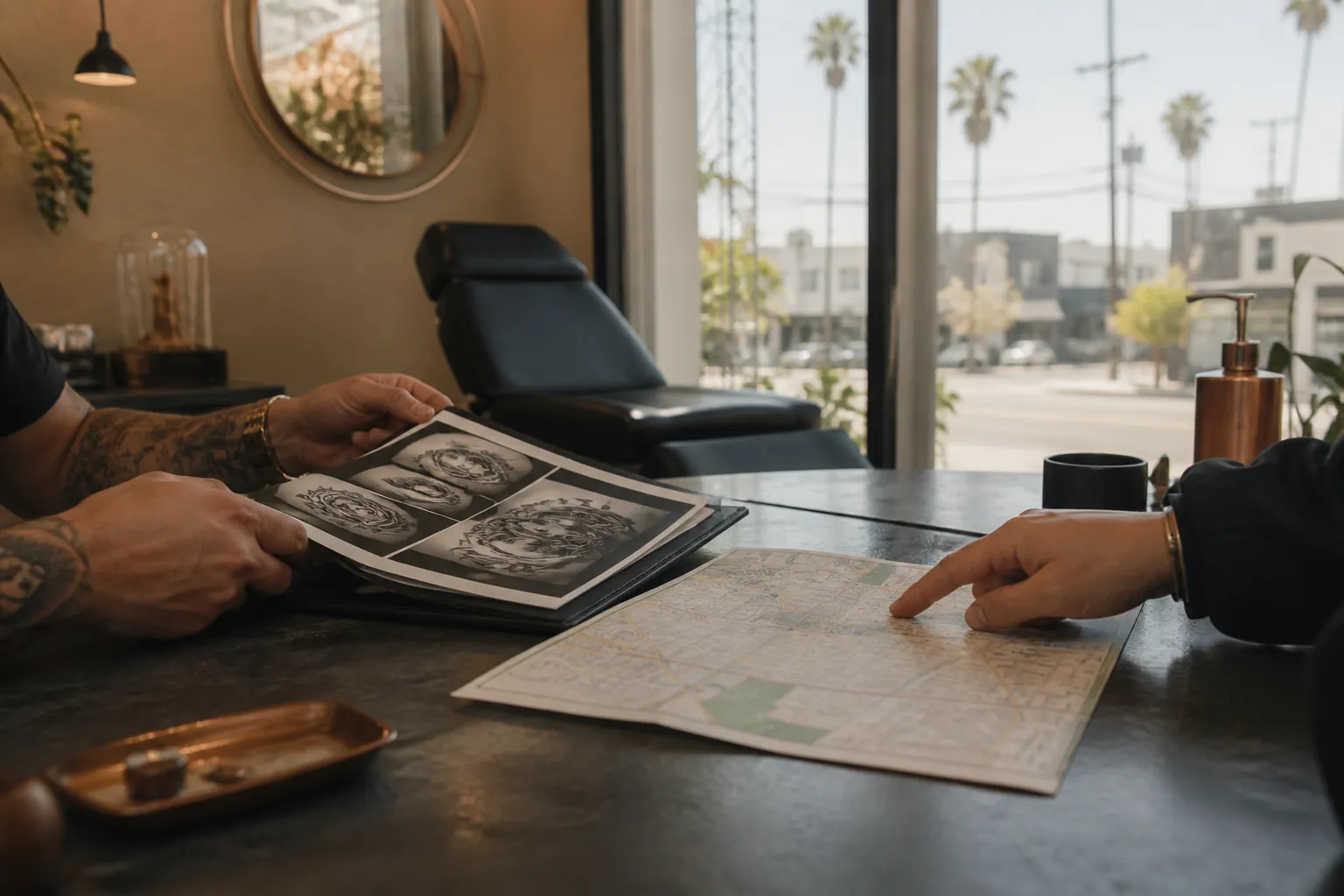
A Los Angeles search works best when visual fit, verified location, and realistic travel time are evaluated together.AI 生成的编辑插图;并非目录中纹身师的作品。
Finding a tattoo artist in Los Angeles can feel like searching several cities at once. The region contains established destination studios, private appointment rooms, neighborhood walk-in shops, traveling artists, and specialists whose work is discovered mainly through social platforms. That abundance is useful only after you define what evidence matters. A large audience, a famous neighborhood, or a fully booked calendar may help you discover someone; none of those signals proves that the artist fits your design, placement, budget, or preferred working process.
This guide is designed for clients, not as a ranking. UFO Calling does not name a “best” Los Angeles artist because the right match depends on the exact tattoo and because portfolios, locations, and availability change. Use the Los Angeles tattoo directory to build a candidate set, then verify current work and regulatory details at the original sources before paying a deposit.
Turn the Idea Into a Searchable Brief
Write down the subject, approximate size, body placement, color direction, and two or three visual qualities you care about. “Black snake on my arm” is too broad to compare intelligently. “Palm-length black-and-gray snake on the outer forearm, with open skin, botanical detail, and a readable silhouette” gives you filters. Add practical constraints such as a one-day visit, mobility needs, a firm maximum number of sessions, or a preference for a quiet private room.
Do not force the idea into the first style label you recognize. Artists may use terms such as fine line, illustrative, blackwork, American traditional, realism, Japanese, ornamental, or neo-traditional differently. Search the term, but compare the work itself. If high contrast and negative space are central to the design, start with the blackwork section and then look for the specific line weight, scale, and body placement you need.
Read Complete Portfolios, Not Only Viral Images
Open the artist's own profile and current studio page. Look for several finished tattoos in the relevant style rather than one exceptional post. Examine line control, value structure, transitions, saturation, and whether the design follows the body instead of appearing pasted onto it. A dramatic close-up can hide how a tattoo reads at conversational distance, so seek both detail views and wider placement photographs. The portfolio-reading guide provides a repeatable review method.
Healed photographs are especially helpful because fresh work is commonly photographed while the skin is red, glossy, or swollen. Healed evidence can show how fine detail settled, whether pale values remained readable, and how dense areas recovered. No portfolio will contain your exact skin, habits, or healing process, so healed images are evidence rather than a guarantee. If you do not see a comparable placement, color palette, skin tone, cover-up, or scar-related project, ask whether the artist can share relevant examples privately.
Confirm that the images belong to the named artist. Reposted inspiration, convention photography, drawings, and collaborative work should not silently become portfolio proof. Reverse-image search suspicious examples and check whether the same artist is credited consistently by the studio. A coherent, smaller portfolio can be more decision-useful than a huge feed that mixes unrelated work without dates or credits.
Treat Los Angeles Geography as Part of the Appointment
A studio that looks close on a map may require a long cross-city trip at the appointment hour. Confirm the full address before booking and estimate travel for the actual day and time, not an ideal late-night route. For a long session, consider parking instructions, transit, accessibility, meals permitted by the studio, and the return trip with a fresh dressing. Do not choose an artist solely because the studio is nearby, but do not ignore the strain of an unrealistic itinerary.
Neighborhood names are discovery aids, not credentials. A profile that says “LA” may refer to the City of Los Angeles, another city in Los Angeles County, a temporary guest spot, or a regional audience while the artist actually works elsewhere. Ask, “At what exact licensed or permitted address will this appointment take place?” before comparing travel or local rules. If the artist has recently moved, confirm that the studio page, booking form, and permit information refer to the same location.
Verify the Practitioner and the Facility in the Correct Jurisdiction
Los Angeles County Public Health says body-art practitioners must register and body-art businesses in the areas it serves must obtain a Public Health Permit or License. The department also notes that Pasadena, Long Beach, and Vernon operate their own environmental-health departments. That boundary matters: a certificate from one authority is not automatically the record you should search for an appointment under another authority. Start with the exact address, identify the responsible agency, and ask it what current documents should exist.
A directory verification badge is not a government authorization. Use UFO Calling's methodology to understand what a source label means, then confirm the legal business name, practitioner name, facility address, expiration date, and current status with the relevant public-health office. A registration supports traceability; it does not certify artistic quality or promise a particular healing result. The credential verification guide explains how to record what is verified and what remains unknown.
Guest Artists and Conventions Require Location-Specific Proof
An artist's home-studio credentials do not by themselves authorize every Los Angeles guest spot or convention booth. Los Angeles County publishes separate information for body-art events and temporary booths. Its current guidance describes practitioner registration, a permitted temporary facility, and event-specific documentation. California practitioners registered in another jurisdiction may have limited mobility under the state's framework, but the applicable limits and paperwork should be confirmed with the enforcing agency before the event.
Ask the host studio or event for the permitted location, the artist's working dates, and the name under which the authorization was submitted. Do not accept “the convention handles it” as the final answer when no one can identify the responsible organizer or booth. For a complete travel checklist, see the U.S. guest-spot and convention guide.
Use the Consultation to Test Fit and Communication
A useful consultation connects your references to the artist's process. Ask what size the design needs to be, how it will interact with the body, what can be changed, and what the artist would remove to preserve readability. Ask who creates the drawing, when you will see it, how revisions work, and whether the artist expects creative freedom. A recommendation to simplify or move the design can be a sign of professional judgment when the reason is clear; automatic agreement is not always better service.
Also ask about communication channels and response expectations. Some Los Angeles artists route bookings through a manager or studio coordinator. That can work well if responsibilities are clear. Identify who answers design questions, who holds the payment, who sends preparation instructions, and whom you contact if illness or travel disruption affects the appointment. Bring the tattoo consultation checklist so practical details are not lost in the visual discussion.
Compare the Full Booking Terms, Not an Hourly Number
Artists may price by project, session, day, or time. Ask what the estimate covers, how many sessions are reasonably expected, whether drawing or setup is included, and which changes could alter the total. Add travel, parking, accommodation, meals, aftercare supplies, and time away from work to your own budget. Do not use an unsourced citywide “average” as proof that one quote is fair or unfair; scope and process differ too much for a single number to explain value.
Read the deposit, cancellation, rescheduling, lateness, design-change, and no-show policies before sending money. Confirm that the payment account belongs to the artist or studio you verified. A deposit may reserve time and compensate preparation, but its treatment depends on the written agreement. The pricing and deposits guide helps you translate a quote into comparable terms without inventing market rates.
Build a Shortlist That Records Unknowns
- Save three to six candidates whose recent portfolios show the style, scale, and placement closest to your brief.
- Record healed evidence, current studio, exact address, responsible jurisdiction, and source date for each candidate.
- Ask the same core questions about design process, hygiene, timing, price structure, deposit, and cancellation terms.
- Mark unavailable evidence as unknown instead of treating it as a positive or negative fact.
- Choose based on the whole evidence set: artistic fit, professional setting, communication, workable logistics, and clear agreement.
Walk away from copied work, pressure to pay through an unverified account, refusal to identify the working location, hostility toward ordinary hygiene questions, or a proposal to tattoo in an improvised setting that cannot be matched to local requirements. Ordinary boundaries are different: an artist may decline copied custom art, protect a drawing until the appointment, limit revisions, or refuse a placement. The key is whether those boundaries are explained before you commit.
The final decision should be explainable in one sentence: this artist is a strong match because the portfolio contains relevant work, the appointment location and professional process are verifiable, the communication is clear, and the written terms fit the project. Los Angeles provides enormous choice; a disciplined search turns that scale from noise into useful evidence.
资料来源
主要参考资料与延伸阅读
外部资料用于核实与补充背景。法规可能变化,请向主管机构确认现行规则。