
City Guides / U.S. field guide
How to Find a Tattoo Artist in New York City: A Five-Borough Research Guide
New York offers enormous choice and equally enormous search noise. Build a shortlist around style and evidence, then verify the person, workplace, and city license before you travel or pay.
This article is published in American English for a U.S. audience.
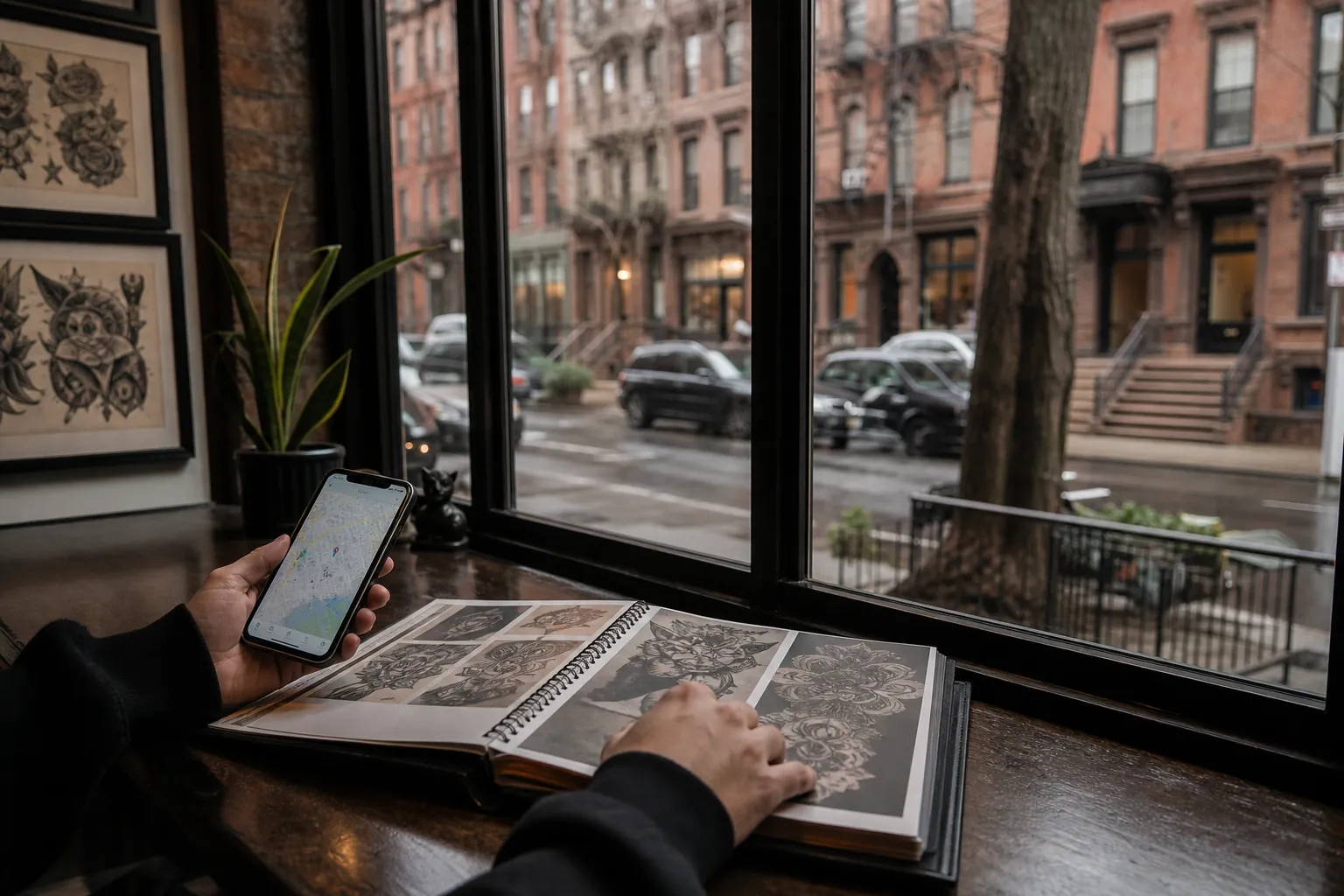
A New York shortlist should connect the artist, style, current workplace, license evidence, and realistic trip across the five boroughs.AI-generated editorial illustration; not a listed artist’s work.
Finding a tattoo artist in New York City is not difficult because the city lacks talent. It is difficult because a single search mixes resident artists, visiting artists, old studio rosters, sponsored posts, copied portfolio images, booking forms, map listings, and “best of” pages whose ranking criteria are unclear. The solution is not a longer unfiltered list. It is a repeatable path from visual fit to identity, current workplace, city license, booking terms, and a trip you can realistically make.
This guide does not rank artists or studios, and inclusion in a directory is not an endorsement. It explains what a client can verify from public evidence and which questions belong to NYC authorities, the artist, the studio, or a consultation. Licensing facts below were checked against official NYC Health, NYC311, and New York City Health Code pages on August 26, 2026. Rules and service details can change, so recheck the official pages before an appointment.
Write a Search Brief Before Choosing a Borough
New York geography is useful after you know what work you need. Begin with subject, visual treatment, approximate placement, flexible size range, color preference, and whether the project is custom, flash, a cover-up, or a continuation of existing work. “Brooklyn tattoo artist” describes a location, not an artistic match. “Brooklyn blackwork artist with large botanical compositions” gives a directory, search engine, or studio roster a meaningful problem to solve.
If the style language is uncertain, use the tattoo styles guide and save five examples with a note about each. Separate subject from treatment: a snake can be traditional, realistic, ornamental, fine line, abstract, or graphic blackwork. Then browse New York City artist listings and all artist profiles. Filters should create a shortlist, not a verdict. Open the underlying portfolio and source trail for every serious candidate.
Search All Five Boroughs Without Turning Neighborhoods Into Stereotypes
Manhattan, Brooklyn, Queens, the Bronx, and Staten Island each contain many neighborhoods and working arrangements. An artist's postal neighborhood does not define their style, price, quality, culture, or availability. Avoid articles that describe one borough as automatically traditional, fashionable, affordable, or experimental. Those claims flatten people and become outdated quickly. Use borough and neighborhood only as logistics: travel time, accessibility, appointment hour, and whether the studio address matches the booking.
- Search the whole city first when specialization matters more than convenience.
- Add a borough when two or more candidates have comparable portfolio relevance.
- Confirm whether the listed address is a studio, private appointment location, or outdated profile field.
- Ask about stairs, elevators, seating, support-person rules, and privacy when accessibility affects the visit.
- Recheck the route on the appointment date rather than relying on the travel estimate saved during research.
Use Directories, Studio Rosters, and Social Platforms for Different Jobs
A structured directory is useful for comparing location, styles, studio relationships, source links, and profile status. A studio website is useful for the current roster, booking policies, address, and guest announcements. An artist-owned site or booking page is useful for portfolio emphasis and current inquiry instructions. Social platforms are useful for recent activity, process, and availability—but a profile can disappear, change handles, or retain old workplace information. No single source answers every question, so UFO Calling's methodology treats each one as dated evidence.
Verify the NYC Tattoo Artist License as a Separate Step
As of the official pages reviewed August 26, 2026, New York City requires a Tattoo Artist License for a person who tattoos in the city. NYC Health says applicants must complete its infection-control course and pass the examination before a license is issued. NYC311 describes a full-term license as valid for two years. New York City Health Code Chapter 22 says a current license must be conspicuously posted wherever the license holder is tattooing while customers are present.
A license is attached to the practitioner; it is not proof that a portfolio image belongs to that person, that a specific studio relationship is current, or that the artist is suitable for your design. Verify those questions independently. Ask the artist for the name shown on the license and confirm current status through the official NYC licensing contact or process identified by NYC311 when an online lookup is unavailable. Do not accept a cropped badge photograph as the whole verification chain.
For a guest artist, convention, or special event, do not assume an out-of-state license automatically authorizes tattooing in New York City. NYC311 states that a Temporary Tattoo License is required to tattoo at a convention or special event and that it expires after seven days. The official NYC Business page adds conditions for temporary applicants. Ask which NYC authorization covers the dates and location, then check the official source again because temporary-license procedures can change.
Licensing answers “may this person legally tattoo here?” Portfolio evidence answers “do they repeatedly make work relevant to my project?” You need both questions, and neither answers the other.
Read a New York Portfolio Without Being Distracted by Reach
Follower count, celebrity clients, press mentions, a long waitlist, and a fashionable neighborhood are attention signals, not direct measures of fit. Open complete projects. Compare several examples with similar style, complexity, and placement. Look for clear authorship and credits when work is collaborative. Distinguish flash designed by the artist from reproductions of another person's image. When fresh and healed images are shown, they should be labeled rather than left for the viewer to infer.
- Find at least several relevant pieces by the same artist and compare full views.
- Confirm the artist's name, handle, current studio, and first-party booking channel agree.
- Check whether the project type—custom, flash, cover-up, continuation, or guest appointment—is accepted.
- Note which facts are current, which are historical, and which remain unknown.
- Contact only the strongest matches with a concise project brief.
Confirm the Exact Studio and Appointment Address
New York artists may move between studios, maintain private appointment spaces, or announce guest dates. A directory record and an old interview can preserve a real historical association after the artist has moved. Before paying, confirm the street address through the artist's official booking channel and the current studio roster. Browse studio profiles for discovery, then compare with the studio's own contact information. If the address changes after payment, pause and verify the new location.
Ask who receives the deposit, who handles rescheduling, and whether the studio or artist controls the policy. Keep the written terms and receipt. Be cautious when a new account contacts you after a public comment, claims a cancellation opened, and requests immediate payment through an unrelated name. Go back to the verified profile or website and initiate the conversation yourself. Popular artists are routinely impersonated; urgency is not identity evidence.
Send an Inquiry That Helps an Artist Answer
Follow the stated booking instructions even if another channel feels faster. Include your name, concept, approximate size range, placement, color preference, relevant existing tattoos, and whether you can travel within the five boroughs. Link two or three examples from that artist's own portfolio and explain what each demonstrates. If dates are limited, state the window without creating false urgency. Do not attach a stranger's tattoo and request an exact copy.
Compare Policy and Communication Before Paying
Ask when the appointment is confirmed, what the deposit reserves, whether it is applied to the balance, and what happens after rescheduling, cancellation, illness, lateness, or a material concept change. Confirm acceptable payment methods and the recipient name. There is no responsible citywide “normal” policy that makes individual terms unnecessary. An artist may have strict terms and communicate them clearly; another may be flexible. Your task is to understand the agreement you are entering.
Discuss design-preview timing and revision boundaries. Many artists do not deliver finished custom art far in advance; that can be a legitimate workflow, but it should not eliminate meaningful consent at the appointment. Ask what happens if the proposed composition differs from the agreed brief. Review tattoo pricing and deposits explained without relying on invented New York averages. Compare scope and terms, not isolated numbers.
Plan the City Visit as Part of the Appointment
At arrival, match the artist and address to the booking, look for the posted current license required by Chapter 22, and review the station rather than relying on the studio's aesthetic. The tattoo studio hygiene checklist explains what a client can reasonably observe. If the location, practitioner, or procedure differs materially from what was confirmed, ask questions before the session starts.
A Seven-Field New York Shortlist
- Artist identity: professional name, verified handle, and matching first-party source.
- Visual fit: several comparable projects and a written reason for the match.
- Current location: studio name, full appointment address, borough, and date checked.
- NYC authorization: full-term or applicable temporary Tattoo Artist License evidence.
- Project scope: custom or flash, placement, cover-up status, and known constraints.
- Booking terms: official channel, deposit recipient, cancellation and revision policy.
- Trip plan: travel time, accessibility, arrival instructions, and return margin.
Fill the fields with links and dates rather than impressions. An unknown field is not a negative score; it is the next question. When the shortlist is ready, compare only the candidates who remain strong on both artistic relevance and verifiable process. New York's size becomes an advantage once search noise is separated from evidence: you can look across the city for a specialist without pretending that popularity, borough, or one license image decides the whole project.
Source desk
Primary References and Further Reading
External sources are provided for verification and context. Regulations can change; confirm the current rule with the responsible authority.